
Ticket Manager Guide
Screenshots
Screenshots show demo data from a test environment.
As a ticket manager, you're the bridge between members and their concert tickets. This guide covers everything you need to manage orders, sales quotas, and external sales effectively.
Your Role
What Ticket Managers Do
You handle the day-to-day ticket operations for your organization:
- Review and approve member ticket orders
- Mark orders as delivered when handing out physical tickets
- Transfer orders between members when needed
- Archive completed orders for a selected event
- Set sales quotas to control how many tickets each member can order
- Log external sales from platforms like Ticketmaster
- Track capacity across all sales channels
- Sell for another organization if your organization has been invited as a selling partner on one of its events
What You Can and Can't Access
| You can do | You can't do |
|---|---|
| Manage orders (approve, reject, deliver) | Create or edit events |
| Set sales quotas | Manage members |
| Log external sales (Ticketmaster) | Change member roles |
| Use the event dashboard and invoice summaries | View financial reports |
| View capacity per showtime | Access organization settings |
| Order tickets (like any member) | |
| Access Registrations directly from sidebar | |
| Archive and restore eligible orders |
INFO
Need access to reports or event management? Talk to your organization admin about upgrading your role.
Managing Orders
The Orders screen is your main workspace. Navigate to it from the Management section in the sidebar.
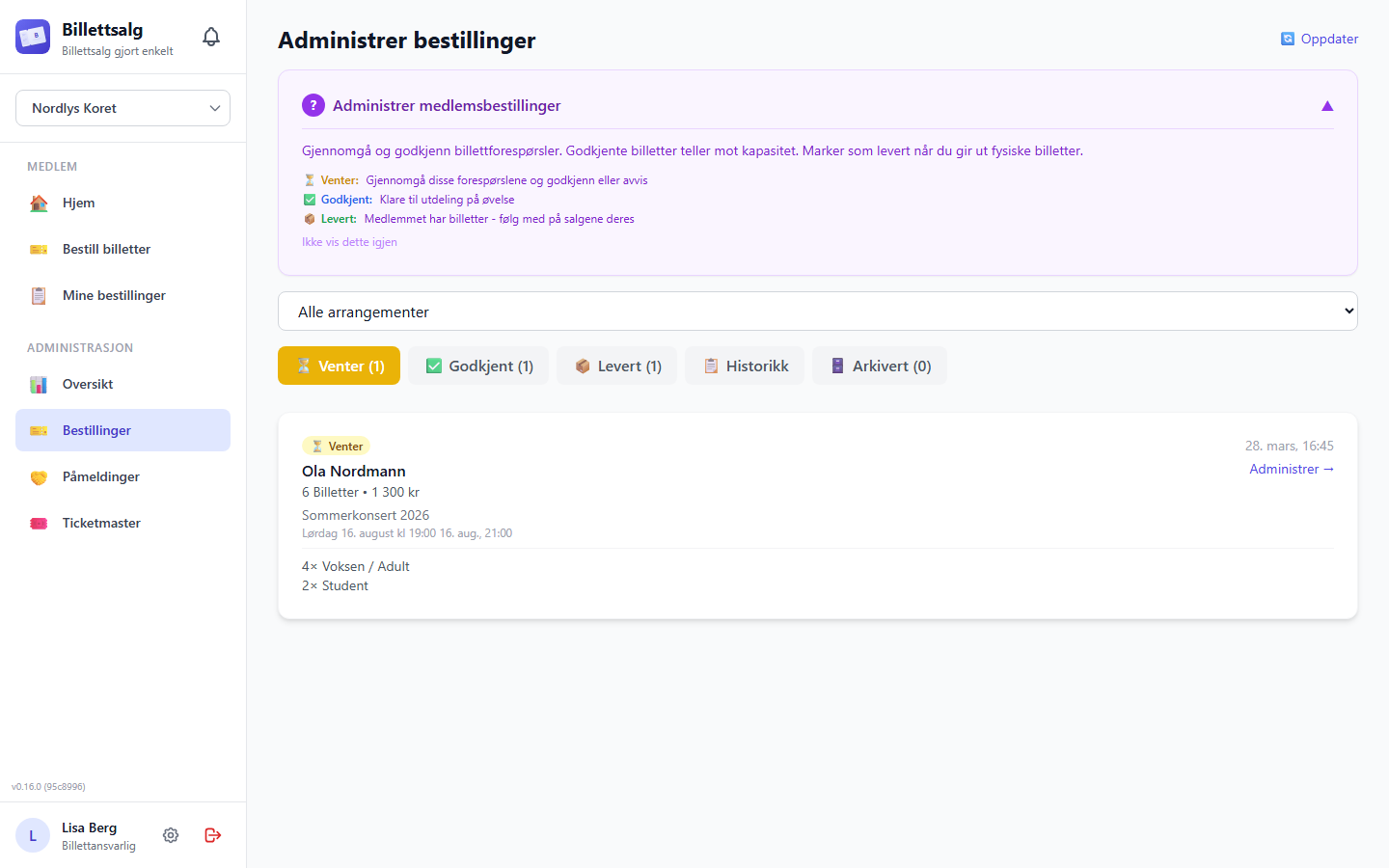
The Orders Screen
At the top you'll find:
- Event filter — a dropdown to filter orders by event. If there's a single active event, it's selected automatically.
- Member-name search: filters the current Pending, Approved, Delivered, or Awaiting Reconciliation queue. It matches part of a member's name, ignores capitalization and surrounding spaces, and works together with the event filter.
- Refresh button (🔄) — tap to reload the latest orders.
Below that are seven tabs, each with a count badge:
| Tab | Icon | What's here |
|---|---|---|
| Pending | ⏳ | New orders waiting for your review |
| Approved | ✅ | Orders you've approved, awaiting ticket pickup |
| Delivered | 📦 | Orders where tickets have been handed over and sales or returns are still being reported |
| Awaiting Reconciliation | 📋 | Orders where every ticket is accounted for and a manager must approve the reconciliation |
| Settled | ✔️ | Reconciliations you approved, with the invoice basis frozen |
| Cancelled | ❌ | Orders cancelled by a member or manager |
| Archived | 🗄️ | Completed orders a ticket manager or higher role archived to keep operational queues tidy |
Each order card shows the member's name, order date, showtime, ticket breakdown, total amount, and a status badge. Tab counts always show the full status total, even when member-name search narrows the visible list.
Reviewing a Pending Order
- Go to the Pending tab.
- Start with the first card. Pending orders always appear oldest first, and each card shows the localized Submitted date and time. Orders submitted at the same instant keep a stable order across refreshes.
- If needed, search by member name or select an event. The filtered Pending results stay oldest first.
- Tap an order card to open the action sheet.
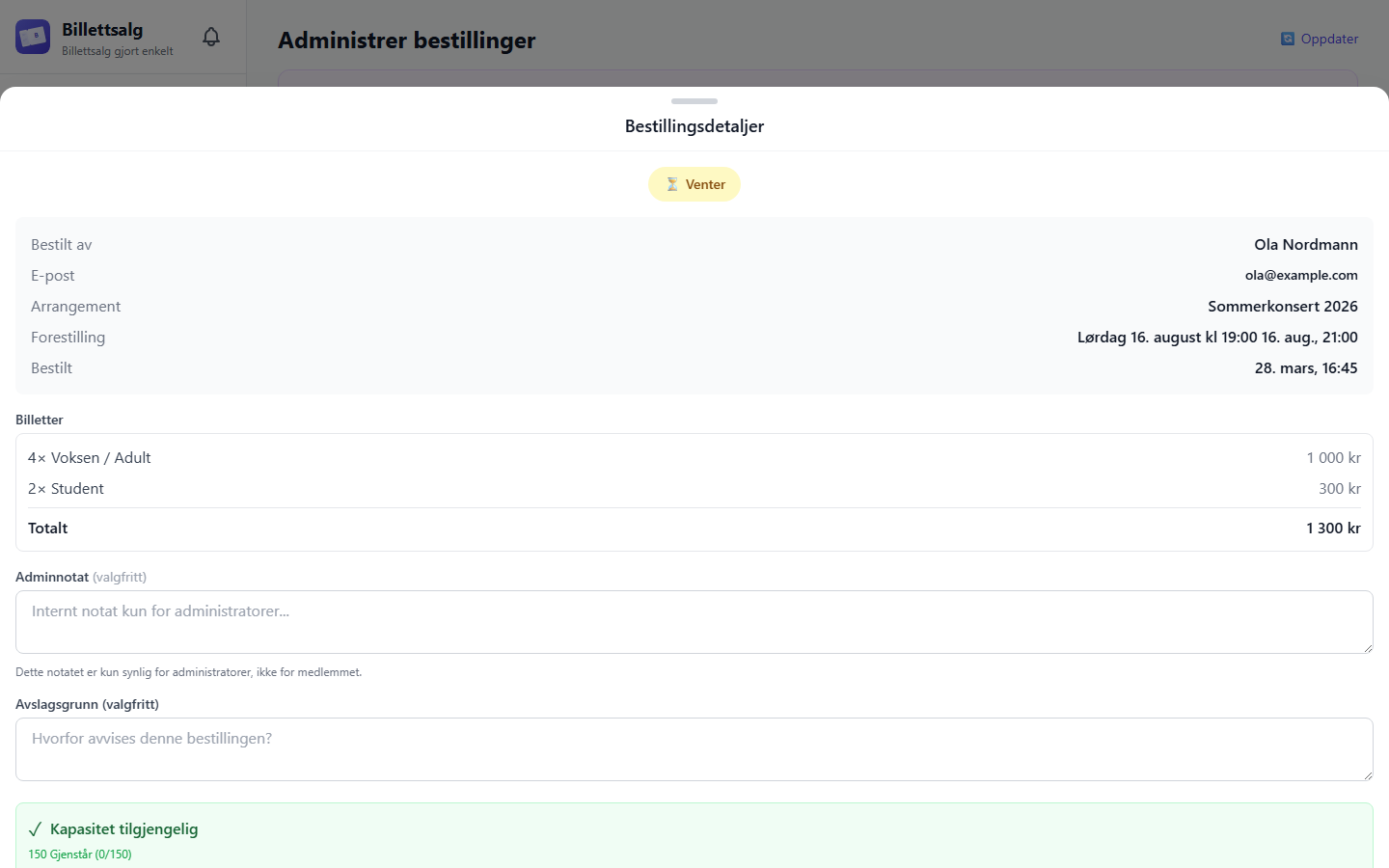
- You'll see the full order details plus a capacity summary:
- Venue capacity
- Total tickets sold
- Remaining capacity
- Pending orders count
This helps you decide whether to approve — if venue capacity is tight, you'll see a warning.
Approving an Order
- Open a pending order's action sheet.
- Optionally add an Admin Note (e.g. "Pick up at Thursday rehearsal").
- Tap Approve.
- Confirm when prompted.
- The order moves to the Approved tab. Approval reserves the order operationally, but capacity changes only when sold tickets are reported.
Capacity check
If the full order is larger than the currently remaining capacity, you'll see a warning: "This order would exceed venue capacity by X tickets." Treat this as planning guidance. Approval itself does not consume capacity, but later reported sales do.
Rejecting / Cancelling an Order
- Open the order's action sheet.
- Enter a Rejection Reason — this is visible to the member when an order is rejected by an admin.
- Tap Cancel.
- Confirm when prompted.
- The order moves to the Cancelled status. Cancelled orders don't affect capacity.
Cancellation vs Rejection
When a member cancels their own order, they see a "Cancel Reason" field. When an admin rejects an order, the member sees the "Rejection Reason" you enter here. Both result in a cancelled order, but the language distinguishes who initiated it.
Marking Orders as Delivered
When you hand physical tickets to a member (usually at rehearsal):
- Go to the Approved tab.
- Open the order's action sheet.
- Optionally add an admin note.
- Tap Deliver.
- Confirm when prompted.
- The order moves to the Delivered tab.
Delivery workflow
A typical flow: approve orders during the week → print ticket lists → hand out tickets at rehearsal and mark each order as Delivered.
Reviewing and approving reconciliation
Members report sold tickets from their own delivered orders and return unsold tickets after the relevant showtime or event has passed. You can record a return on a member's behalf. Reporting sales on behalf of a member requires an Admin or Super Admin.
When sold plus returned equals the original order quantity:
- Open the Awaiting Reconciliation tab.
- Open the order and verify the sold, returned, and outstanding totals. Outstanding must be zero.
- Review the sold, returned, and invoice-basis information. The basis uses only sold quantities and the prices saved with the order.
- Select Approve reconciliation.
- Confirm the action.
Approval changes the order to Settled, records who approved it, and freezes the invoice basis. A fully returned order freezes a valid zero-value basis. A partial sale must have complete, consistent per-ticket-type sales detail; otherwise approval stops with a clear correction message. The original order total is never used as a fallback. Approval does not issue or send an invoice. The member sees the order in the Settled tab.
Issuing member invoices
From the dashboard or member sales detail, use the member-and-event invoice action after printed orders are settled. One action covers active direct registrations and eligible settled printed orders for that member and event. The displayed amount includes direct registration totals and valid sold-only printed invoice bases.
The invoice summary distinguishes orders still waiting for settlement, invalid legacy bases that need correction, records ready to invoice, partial invoice state, and fully invoiced state. Invoiced means the invoice was issued or sent. It does not mean payment was received.
Transferring Orders
Need to move tickets to a different member? Maybe someone can't make the show and wants to pass their tickets along, or two members want to swap.
When transfers work:
Transfers are available for orders in the Approved or Delivered status, and they move only the order's outstanding tickets — the ones nobody has reported as sold or returned yet. Reporting some sales on an order no longer blocks transferring it; it just narrows what's left to move. A transfer is only blocked once nothing is outstanding anymore (every ticket on the order has already been sold or returned).
The transfer flow:
- Open the order's action sheet from the Approved or Delivered tab.
- Tap Transfer.
- Choose the transfer type:
- Transfer entire order — Only available while the whole order is still outstanding (nothing sold or returned yet). The order is reassigned in place to the recipient, with the same status and quantities.
- Transfer some tickets — Split off some outstanding tickets into a new order for the recipient; the rest (including anything already sold or returned) stays with the current owner. This is the only option once any sales or returns have been reported on the order.
- Set quantities per ticket type — Use the + / − buttons to select how many of each type to transfer, up to what's still outstanding for that type (not the original ordered quantity). If some tickets on the order are already sold or returned, a notice explains how many outstanding tickets remain and can move.
- Search for the recipient — Type at least 2 characters of a member's name or email. Tap the member to select them.
- Optionally add a reason for the transfer (e.g., "Member requested", "Swap for different showtime").
- Review the preview one more time, then tap Transfer {n} tickets.
The submit button stays disabled until you've selected at least one outstanding ticket and a recipient.
What happens after the transfer:
- Full transfer — The original order is completely reassigned in place: same order, same status, same quantities, now owned by the recipient. The recipient sees it in their own History view under the matching tab (Active or Delivered), with a 🔄 Transferred to you badge and the full transfer history.
- Partial (outstanding) transfer — Two orders result:
- The original order stays with the original member, now showing only the remaining tickets. Anything already sold or returned on it is untouched — that evidence never moves. If the transfer clears the last outstanding tickets on a Delivered order, that order moves straight to Awaiting Reconciliation, exactly as if the last tickets had been reported sold or returned instead of transferred.
- A new order appears for the recipient with the transferred quantity, marked Received via transfer, starting with nothing sold or returned yet, and carrying the transfer history.
Both orders remain in normal operational queues — no special archiving. The transfer history is visible to managers on both orders via the Order History link.
Transfer history
Every order includes a History link showing all transfers affecting that order. Click it to see a timeline of when tickets moved between members, who performed the transfer, and any reason recorded. If an order originated from a selling partner's delegated sale before it was transferred to your organization, the history preserves that as an audit note — it never grants the partner any ongoing access to the order.
Transfers and reconciliation
A transfer only ever moves outstanding (unreported) tickets — sold and returned quantities, and their per-ticket-type evidence, always stay on the order they were reported against. A transfer is blocked only once an order has zero outstanding tickets left (everything on it has already been sold or returned); as long as any outstanding balance remains, it can still be transferred, in full or in part.
Transfer examples:
| Scenario | Result |
|---|---|
| Transfer all 2 "Adult" tickets from Alice to Bob (nothing reported yet) | Bob receives the same order, reassigned in place, still "Approved", marked "Received via transfer". |
| Alice's order has 1 "Adult" ticket already sold; transfer the remaining 1 "Adult" + 1 "Child" to Bob | Alice's order keeps its sold ticket and moves to Awaiting Reconciliation (nothing outstanding left on it). Bob receives a new "Delivered" order with 1 Adult + 1 Child, marked "Received via transfer", starting with 0 sold and 0 returned. |
| Try to transfer an order with zero outstanding tickets left | Transfer is blocked. Alice sees the error: "This order has no outstanding tickets left to transfer — every ticket has already been sold or returned." |
| Try to transfer more tickets of a type than are outstanding for it | Rejected. Alice sees an error naming how many of that type are still outstanding. |
Adding Admin Notes
You can add or update notes on any order:
- Open the order's action sheet.
- Type in the Admin Note field.
- The note is saved when you take an action (approve, deliver, etc.).
Admin notes are internal — they help you and other managers track context about an order.
Archiving Orders
Ticket managers and higher roles can archive completed orders. A cancelled order is eligible when it is not deleted or already archived. A settled order also needs a valid frozen invoice basis and an issued invoice.
To archive completed orders in bulk:
- Select one specific event in the event filter.
- Select Archive completed orders.
- Review the preview. It shows the exact eligible total, the breakdown of settled and cancelled orders, and counts blocked by missing invoice state or an invalid invoice basis.
- Confirm the archive action.
Each server request archives at most 100 orders. The screen runs up to 10 requests, so one action can archive at most 1,000 orders. Execution requests are not automatically retried. If more eligible orders remain, the result tells you how many are left. Run the action again to continue.
The selected organization is fixed when the action starts. If you switch organizations during preview, confirmation, or processing, the action stops before another batch is sent. After any execution attempt, the order list reloads. If a server failure happens after some orders were archived, the message reports the durable processed, conflict, and skipped counts; the remaining count can be shown as unknown if it could not be read safely.
You can also archive one eligible order from its action sheet. Individual archive uses the same normal rules as bulk archive. Ticket Managers and Treasurers cannot bypass an invoice or basis blocker. Ask an organization admin to review the order.
An archived order shows a neutral 🗄️ Archived badge on the card and in the action sheet. Archiving is presentation-only. It keeps the order's lifecycle status, ticket sales and returns, reconciliation, financial records, and other order history unchanged.
You can restore an order from the Archived tab. Restoring removes the archive audit fields, and the underlying lifecycle status determines which tab and status badge the order returns to.
Ticket Sales Quotas
What Are Sales Quotas?
Sales quotas let you limit how many tickets each member can order for a specific event. They're an opt-in feature — you enable them per event when you want fair distribution among members.
Example: Your spring concert has 200 seats. You want each of your 20 members to sell a maximum of 10 tickets each. Enable quotas on the event, then set each member's quota to 10.
When a member has a sales quota:
- They see their remaining quota on the order form.
- They can't order more than their allocated amount.
- If they have no quota set, they can order freely (no limit).
Enabling Sales Quotas on an Event
Sales quotas are per event and opt-in. An admin must enable them before you can manage quotas:
- Go to Management → Events and open the event you want to manage.
- In the event settings, toggle "Enable sales quotas" on.
- Click Save.
- Back on the event dashboard, a "Manage Quotas" button now appears.
TIP
If you don't see the "Manage Quotas" button, check that the event has "Enable sales quotas" turned on in its settings.
The Quotas Management Screen
Click "Manage Quotas" from the event dashboard to open the quotas view, filtered to that event.
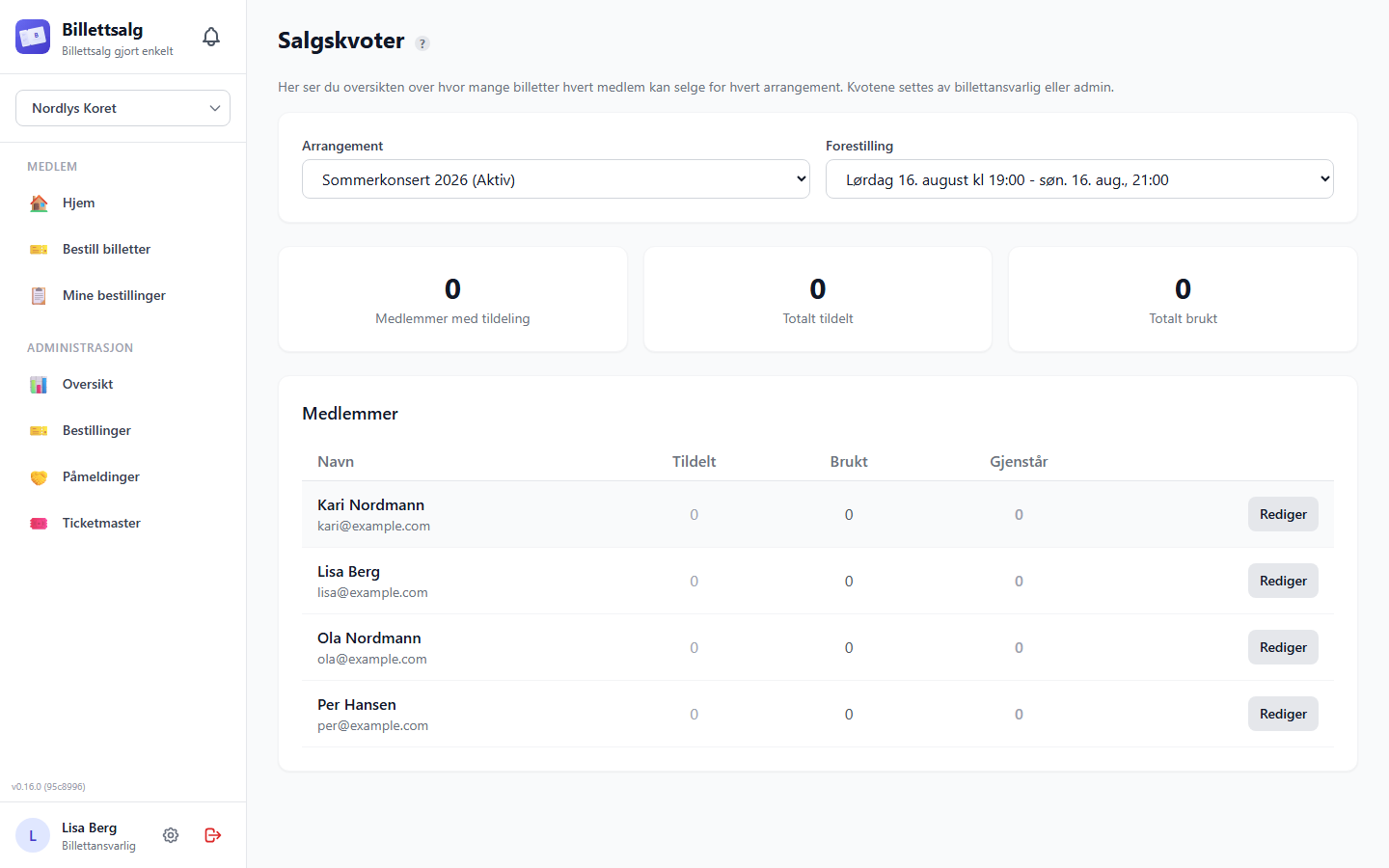
At the top:
- Showtime selector — filter by a specific showtime or view all.
Summary cards show:
- Members with allocation — how many members have tickets allocated
- Total allocated — sum of all allocated tickets
- Total used — how many allocated tickets have been ordered
Below is the members table with columns for each member's name, allocated count, used count, remaining count, and an edit button.
Creating and Editing Quotas
- Open the quotas screen from the event dashboard (see above).
- Select the showtime you want to manage.
- Find the member in the table and tap Edit (pencil icon).
- The edit sheet opens showing each ticket type with its price.
- Use the + / − buttons to set the quantity for each ticket type.
- Tap Save.
INFO
If the member has already ordered tickets, the sheet shows "Currently used: X tickets" so you know how many of their allocation is spoken for.
How Sales Quotas Relate to Orders
- Sales quotas set the maximum a member can order per ticket type.
- When a member orders tickets, the system checks their remaining quota.
- If they've used their full quota, the ticket type shows "Quota used up" on their order form.
- Sales quotas are per showtime — a member might have different limits for the Saturday vs. Sunday show.
- Quota limits are only enforced when the event has sales quotas enabled. If quotas are disabled on the event, members can order without limits.
Registration rounds → Sales Quotas
If your organization runs registration rounds (pledges), the admin can convert pledges into sales quotas automatically. This seeds each member's quota based on their pledge. You can also access Registrations directly from the sidebar under the Management section for quick pledge management.
External Sales (Ticketmaster)
What Are External Sales?
Not all tickets are sold by members. Some are sold through external platforms like Ticketmaster, box offices, or partner organisations. You track these separately so the capacity numbers stay accurate.
The Ticketmaster Screen
Navigate to Ticketmaster from the Management section in the sidebar.
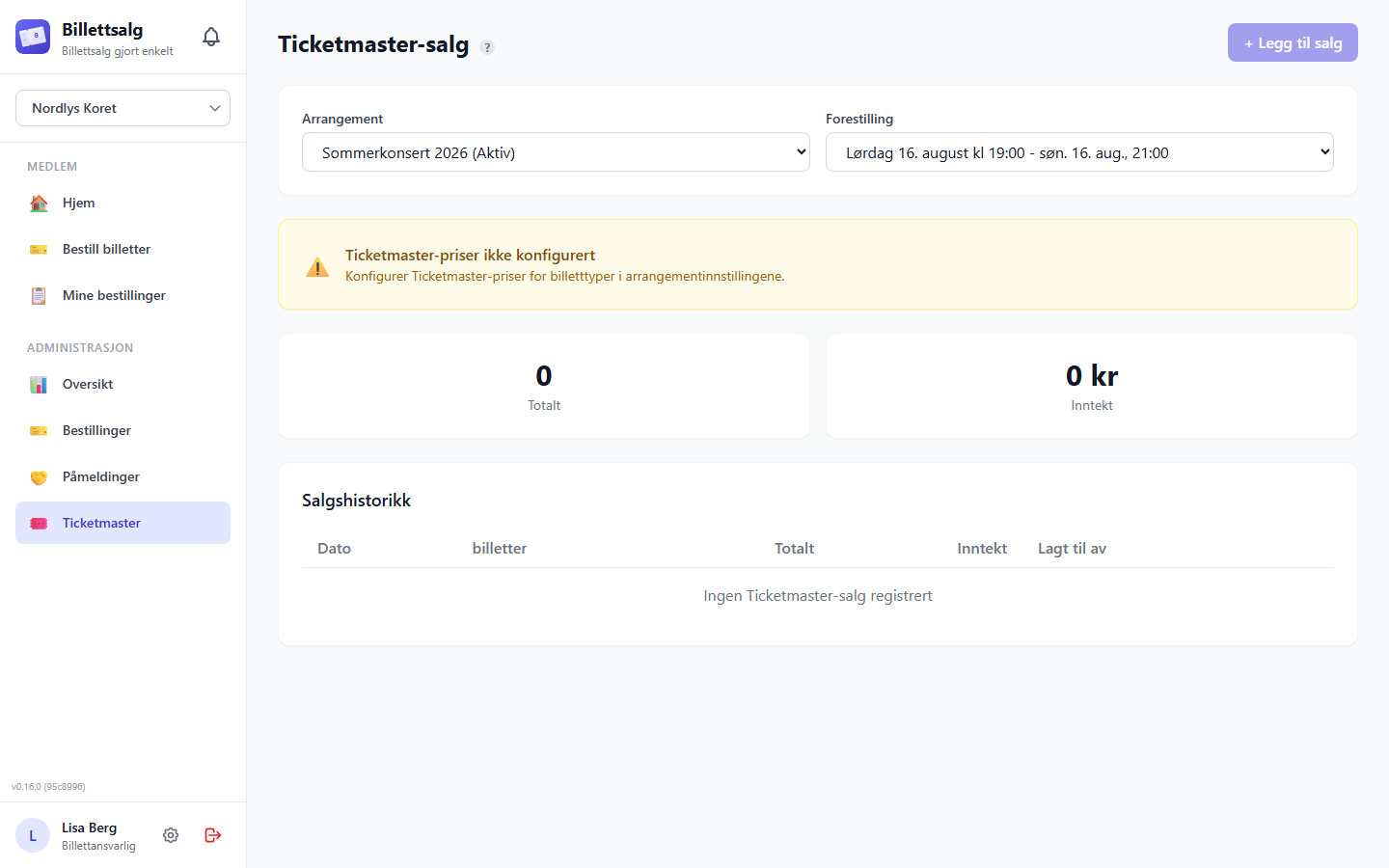
The screen shows:
- Event and showtime selectors at the top
- Ticketmaster pricing — a card showing the configured price and fee for each ticket type (set by the admin in event settings)
- Summary stats — ticket counts and revenue broken down by ticket type
- Sales history table — each row showing date, ticket breakdown, total quantity, revenue, who added it, and a delete button
No pricing configured?
If you see a yellow warning saying "No Ticketmaster pricing configured", ask your admin to set up Ticketmaster prices in the event settings.
Logging an External Sale
- Select the event and showtime.
- Tap + Add Sale.
- The add-sale sheet opens with each ticket type:
- Set quantities using + / − buttons.
- You'll see the unit price × quantity calculation.
- The fee is added to the ticket price. The total shows: price + fee.
- Optionally add a note (e.g. "Batch from March 15 sale").
- Review the preview showing total amount and quantity.
- Tap Add Sale.
Deleting an External Sale
If you logged a sale in error:
- Find the entry in the sales history table.
- Tap the trash icon (🗑️).
- Confirm when prompted.
How External Sales Affect Capacity
External sales are added to the sold count for the selected showtime:
Total Sold = Member-reported sold tickets + Direct registrations + External sales + Free ticketsThis means every Ticketmaster sale you log reduces the remaining capacity for that showtime only. Keep the selected showtime and quantities accurate so one performance does not appear fuller or emptier than it is.
Capacity Overview
Understanding Capacity
Every event has a venue capacity (set by the admin) that applies separately to each showtime. For a multi-showtime event, the all-showtimes view adds the capacities and remaining seats from each performance. An oversold showtime never borrows unused seats from another showtime.
| Source | Counts toward capacity? | Counts toward revenue? |
|---|---|---|
| Member-reported sold tickets | ✅ Yes | ✅ Yes |
| Direct registrations | ✅ Yes | ✅ Yes |
| External sales (Ticketmaster) | ✅ Yes | ✅ Yes (external) |
| Free tickets (comps) | ✅ Yes | ❌ No |
| Pending, approved, or delivered but unsold order quantities | ❌ No | ❌ Not yet |
For standalone events with multiple showtimes:
- The capacity panel starts with an all-showtimes total and a per-showtime breakdown.
- Select a showtime to scope capacity, sales, revenue, and remaining seats to that performance.
- The sales tab lists member sales, external sales, total sold, remaining seats, and revenue per showtime, followed by a totals row.
- Event cards can expand to show sold, capacity, and remaining seats for each showtime.
Shared Event projections use authoritative shared capacity totals. The ticket-manager capacity summary and expandable event cards currently omit the per-showtime breakdown for Shared Events, so don't treat a local projection as a cross-organization per-showtime report.
Capacity Indicators
When reviewing orders, the action sheet shows capacity status:
- "Capacity available" — plenty of room
- "Near capacity" — getting close to sold out
- "Capacity exceeded!" — more tickets sold than the venue holds
Keep capacity numbers accurate
Log external sales promptly so the capacity numbers are reliable when you're approving member orders. Approving orders that push past venue capacity can create headaches on show day.
Selling for Another Organization (Delegated Events)
An event admin at another organization can invite your organization to sell tickets on their behalf for one of their events. This is a scoped, delegated selling relationship — your organization's own members order the concert themselves through their normal Home and Bestill billetter screens, and your organization approves and delivers those self-service orders. Your organization never gets any of the owning organization's management controls.
Accepting an invitation
An admin at the owning organization sends your organization a one-time invitation link. Your organization's admin uses that link to accept, or can decline the invitation instead. Once accepted, the event appears in your Delegated Events list automatically, and — once your organization admin turns on ordering for it — in your own members' regular concert catalog. There's nothing further for you to configure.
The Delegated Events List
Once your organization has an active delegation, open Delegated Events (🔗) from the sidebar — visible to ticket managers and above. It lists every event currently delegated to you:
- The event's name and date
- "Selling on behalf of {owner organization}", so it's always clear whose event you're selling for
- A "Sales locked" indicator if the owner has closed sales for the event
- A Sell button that opens the sell/report screen for that event
If the owner revokes your delegation, the event disappears from this list and any in-progress work on its sell screen becomes unavailable.
Reviewing member self-service orders
Open an event from the list to reach its dedicated screen. The primary workflow here is the approval queue: your own members order tickets for this concert themselves, exactly like any other concert, and their orders land in this queue waiting on your organization's approval.
- Pending tab — self-service orders your members placed, waiting on your review. For each order you can:
- Approve — moves the order to Approved, awaiting pickup.
- Approve and deliver — approves and immediately marks the order delivered in one step, for when you're handing over tickets on the spot.
- Approved, awaiting pickup tab — orders you've approved. Mark delivered once the member has the physical tickets.
- Report sold / Report returned — for a delivered delegated order, record how many tickets were actually sold or returned, per ticket type, exactly like reporting on a regular order.
You only ever see and act on your own organization's members' orders for this event — never the owner's own orders or another partner's orders.
Alternative: creating an order manually
Most members now order their own tickets, which appear in the approval queue above. The sell screen still offers a manual create an order form for the cases self-service doesn't cover — for example, a cash sale you're recording yourself at rehearsal for a member without a device or account access. Pick a showtime (if the event has more than one), choose a buyer from your own organization's approved members, set quantities per ticket type, and submit. An order created this way is delivered immediately with no approval step, so make sure quantities are right before you submit. Remaining capacity is shown per showtime as a guide, not a hold — if the owner's venue capacity fills up before your order is submitted, the order is rejected with a capacity error and nothing is created.
What You Can't Do
Your organization's access to a delegated event deliberately does not include:
- Cancelling an order that is already approved or delivered, refunding, or transferring tickets to or from any order
- Reconciling, settling, or invoicing
- Archiving orders
- Any event, pricing, ticket-type, or capacity configuration
Your organization can cancel one of your members' own orders only while it is still pending — the same escape hatch a member has for their own order, extended to your ticket managers so a mistaken order isn't stuck waiting on an approval that may never come. Everything above remains solely with the owning organization. If you need something outside approving, delivering, cancelling a pending order, and reporting sold/returned, contact the owner organization directly.
If your delegation is revoked
The owning organization can revoke your access at any time. Once revoked, you immediately lose the ability to approve, deliver, cancel, or report sold/returned on this event, and your members no longer see it in their own catalog — any orders you already delivered stay in the owner's records as-is. A revoked delegation is permanent; the owner would need to send a brand-new invitation to restore your access.
If the owner deactivates the event or locks its sales
Deactivating an event, or locking its sales, stops new orders only. A deactivated event disappears from your members' catalog and new orders for it are refused; a sales lock refuses new orders while the event stays visible. Neither one strands the orders you already hold: while your delegation is still active, you can continue to approve, mark delivered, cancel a pending order, and report sold/returned exactly as before. Revocation, and the owner deleting the event, are the stops that end your access outright.